How Service Businesses Earn Citations in AI Search
A practical guide for U.S. service businesses to improve ChatGPT search visibility and earn credible citations through technical SEO and useful content.
In this article
AI search is becoming a new discovery layer for plumbers, law firms, contractors, agencies, home-service providers, and other local service businesses. A prospective customer may ask ChatGPT, Google AI, Perplexity, or another assistant to recommend providers, compare services, explain pricing factors, or identify businesses serving a specific area.
The businesses included in these answers are not selected by one universal ranking formula. Retrieval is query-dependent, and major vendors do not publish a complete source-selection formula. However, consistent patterns are practical to act on: AI systems need accessible pages, clear answers, verifiable business facts, useful structure, and credible signals beyond the company’s own website. Research on AI citation visibility supports this operating model.
This guide presents a diagnostic and implementation checklist for earning service business AI search citations. It connects technical SEO, local business data, service-page architecture, reviews, and third-party credibility to the way AI-mediated search experiences retrieve and summarize information.
How AI Search Selects Sources to Cite for Local Services
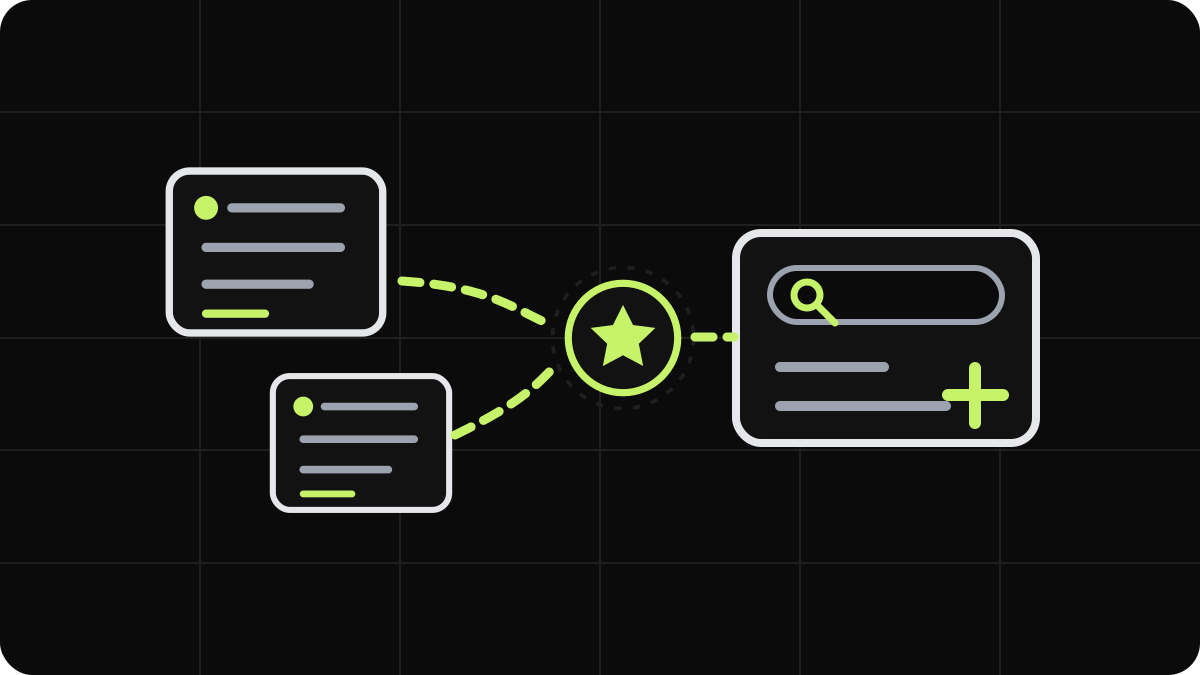
An AI-generated answer typically combines retrieval, entity understanding, and answer synthesis. For a local service query, the system must determine several things:
- Which business provides the requested service
- Whether the business serves the user’s location
- Whether the business appears legitimate and relevant
- Which source clearly explains the service
- Whether important claims can be corroborated
- Whether the information appears current and consistent
A citation is not the same as a brand mention. A mention names a company without necessarily linking to its source. A citation attributes information to a source, often through a link, numbered footnote, inline reference, or source chip. Perplexity’s footnotes, ChatGPT’s inline links, and Google AI result source references are examples of citation formats described in this guide to tracking AI search citations.
Both outcomes matter:
- Mentions indicate that an AI system recognizes your business entity.
- Citations indicate that a page or external source was used to support an answer.
- Referral visits show whether users followed the source.
- Conversions show whether the visit produced a call, form submission, booking, or purchase.
A service business should not treat citation visibility as a replacement for conventional SEO. Google states that existing fundamentals—crawlability, useful content, clear organization, and strong page experience—continue to apply to AI features in search. See Google’s guidance on AI features and websites.
The five source-selection signals to improve
1. Accessibility
Important pages must be discoverable and retrievable. Confirm that:
- Search engines are not blocked by
robots.txtrules that affect key content. - Important service pages return a successful HTTP status.
- Canonical tags identify the preferred URL.
- Internal links connect the homepage, location pages, service pages, and contact paths.
- Content is available in rendered HTML rather than only after an inaccessible client-side interaction.
- XML sitemaps include indexable service and location URLs.
- OAI-SearchBot access is reviewed if ChatGPT search referrals are relevant to your acquisition strategy. OpenAI provides publisher and developer guidance in ChatGPT search for publishers and developers.
Accessibility also includes human usability. A page that is technically crawlable but difficult to read, slow to load, or unusable with a keyboard is less effective as a conversion asset.
2. Answer clarity
AI systems need extractable passages. A page should answer a specific question near the relevant heading instead of forcing the reader—or a retrieval system—to interpret broad marketing language.
Examples:
- “Do you provide emergency water heater repair in Phoenix?”
- “How much does commercial exterior painting cost?”
- “What areas does your electrical service cover?”
- “How long does a standard roof inspection take?”
- “What is included in a drain cleaning appointment?”
Give the direct answer first, then provide context, boundaries, exceptions, and the next step.
3. Entity clarity
Your business name, address, phone number, service area, hours, categories, credentials, and service descriptions should agree across:
- Your website
- Google Business Profile
- Relevant directories
- Industry associations
- Licensing or certification profiles
- Customer review platforms
- Social profiles
- Partner websites
- Press coverage
- Videos and business profiles
Inconsistent facts create ambiguity. A business that uses one name on its website, another in directories, and different service-area claims in social profiles is harder to identify and corroborate. AI search research on entity consistency recommends treating consistent company and product facts as a core visibility requirement.
4. Evidence and first-hand expertise
A generic service description is easy to produce and difficult to distinguish. Stronger pages document how the business works:
- Defined service scope
- Inspection or intake process
- Common project constraints
- Service-area limitations
- Safety or compliance requirements where applicable
- Before-and-after project documentation
- Original photographs
- Author or reviewer credentials
- Clear pricing factors
- Maintenance or preparation guidance
- Customer questions derived from actual operations
Do not publish invented case studies or unsupported performance claims. If a claim cannot be verified internally or through a reliable primary source, remove it or qualify it.
5. Third-party validation
Owned content establishes the company’s source of truth. Independent sources help validate that the entity is real, relevant, and trusted. Depending on the service category, useful sources may include:
- Local news coverage
- Industry publications
- Trade associations
- Chambers of commerce
- Licensing directories
- Vendor or manufacturer partner pages
- Relevant review platforms
- Community organizations
- Expert interviews and podcasts
The objective is not to purchase low-quality links. It is to earn accurate, relevant references that corroborate the business and its expertise. Research on how AI search engines choose citations emphasizes earned authority, entity clarity, and citation architecture rather than relying on traditional rankings alone.
Audit Your Technical SEO and Local Business Data
Begin with an inventory, not a content rewrite. The goal is to identify whether an AI system, search crawler, or human can reliably understand and validate the business.
Technical SEO diagnostic checklist
Review the following for every revenue-generating service and location URL:
- Is the page indexable?
- Does it return
200 OK? - Is the canonical URL correct?
- Is the page included in the XML sitemap?
- Is it linked from a relevant, crawlable page?
- Does the page work without critical JavaScript failures?
- Are headings logically nested?
- Does the page have a unique title and meta description?
- Are images compressed and supplied with descriptive
alttext? - Are forms usable on mobile and with a keyboard?
- Are phone links clickable on mobile?
- Is the page served over HTTPS?
- Are intrusive pop-ups blocking the primary content?
- Does the page meet reasonable Core Web Vitals targets?
Google’s SEO Starter Guide and guidance on helpful, reliable, people-first content provide the baseline. For implementation, measure real-user performance where possible rather than relying only on a desktop lab test.
Performance is especially important for local service pages because many users arrive on mobile devices and need to call or submit a request quickly. Prioritize:
- Fast server response and efficient caching
- Properly sized images
- Reduced JavaScript execution
- Stable layout during loading
- Lightweight form and analytics scripts
- Sub-second latency for critical interactions where practical
Do not optimize for a theoretical score while damaging usability. Conversion engineering should preserve clear calls to action, readable service explanations, and accessible forms.
Local business data checklist
Create a single internal record for the following facts:
- Legal or public-facing business name
- Main phone number
- Primary address
- Service-area boundaries
- Regular and exceptional hours
- Primary and secondary business categories
- Services offered
- Booking or quote URL
- Contact email
- License or certification details
- Ownership or operating entity
- Locations and location-specific phone numbers
Use that record to audit every public profile. For a multi-location business, maintain location-level records rather than copying one generic description to every market.
On the website, provide a clear contact page and location pages where appropriate. Include visible business information in HTML, not only in an image or embedded widget. Use structured data to describe the business, but do not treat schema as a substitute for visible, accurate content.
Structured data implementation
Depending on the page, evaluate:
LocalBusinessor a more specific subtypeOrganizationServiceBreadcrumbListFAQPage, only when the questions and answers are visibly present and meet search-engine requirementsRevieworAggregateRating, only when the markup is eligible and accurately represents visible reviews
Structured data helps machines interpret content; it does not guarantee enhanced search results or AI citations. Keep fields synchronized with the page. Do not mark up services, ratings, locations, or credentials that users cannot verify.
Local data controls
Assign ownership for recurring checks:
- Weekly: test phone numbers, forms, booking links, and urgent service pages.
- Monthly: review business profiles, hours, categories, and service-area descriptions.
- Quarterly: audit directory consistency, schema, sitemap coverage, and obsolete pages.
- After any operational change: update the website and external profiles from the same source record.
This is a workflow automation opportunity. A simple system can flag differences between a central business-data table and published profile information. Automation should have a bounded scope: detect, report, and route changes for review before updating external platforms.
Build Service Pages That Answer AI Search Questions
A service page should function as both a sales page and a reliable reference. The strongest structure makes each section useful on its own while preserving a clear path to conversion.
Recommended service-page architecture
1. State the service and market
Use a descriptive heading and opening paragraph:
Commercial HVAC maintenance for facilities in Columbus, Ohio
Explain who the service is for, what problem it addresses, and the geographic area covered. Avoid vague openings such as “solutions for all your needs.”
2. Provide a direct answer
Under a query-based heading, answer one high-intent question in approximately one short paragraph. The exact length should follow the complexity of the question, not an arbitrary word count.
Example:
What does a commercial HVAC maintenance visit include?
A maintenance visit typically includes an equipment review, filter and component inspection, operating checks, documentation of observed issues, and recommendations for follow-up work. The exact scope depends on the equipment type, site conditions, and the maintenance agreement.
This format is useful to customers and gives retrieval systems a self-contained passage.
3. Define inclusion and exclusion boundaries
Specific boundaries increase trust and reduce sales friction. Explain:
- What the standard service includes
- What requires a separate quote
- What information the customer should provide
- Whether emergency service is available
- Which property types are supported
- Which locations are outside the operating area
- Whether permits, materials, or third-party fees are separate
For service businesses, clear limitations are often more credible than universal claims.
4. Explain the process
Use numbered steps:
- Submit a request or call.
- Confirm the location and service need.
- Schedule an appointment.
- Complete the assessment or service.
- Document findings and next actions.
- Receive an invoice, quote, or service summary.
Connect the process to your lead capture pipeline. Form submissions should collect only information needed for qualification and scheduling. Send confirmation messages, route the lead to the correct team, and log delivery failures.
5. Explain pricing factors without inventing prices
If exact pricing varies, identify the variables:
- Property size
- Equipment type
- Access conditions
- Materials
- Travel distance
- Urgency
- Labor complexity
- Permit requirements
- Ongoing maintenance needs
A useful pricing explanation is better than a fabricated “starting at” amount that applies only to unusual circumstances.
6. Add proof that can be verified
Use original evidence such as:
- Named team qualifications
- Business licenses
- Manufacturer certifications
- Inspection checklists
- Process photographs
- Anonymized project patterns
- Published policies
- Clearly attributed customer reviews
Do not create fictional project outcomes. If you do not have approved case-study claims, use process evidence instead.
7. Answer objections and related questions
Build an FAQ from real calls, chat transcripts, sales notes, and service tickets. Questions may cover:
- Service availability
- Appointment timing
- Preparation requirements
- Warranty terms
- Cancellations
- Payment methods
- Follow-up work
- Commercial versus residential scope
- Coverage limitations
Use plain language and answer each question directly. A centralized FAQ hub can support broader discovery, but important answers should also appear on the relevant service page.
8. Present a clear next action
Every service page should have a primary conversion path:
- Call the business
- Request a quote
- Book an appointment
- Submit a project inquiry
- Visit a location
Use a consistent form and instrument events such as form_start, form_submit, phone_click, and booking_complete. If payments are part of the workflow, a secure Stripe integration can support deposits or invoices, provided the business defines refund, cancellation, and fulfillment rules before implementation.
Link service pages to the approved service scope
Keep commercial promises aligned with actual delivery capacity. For example:
- Web & Workflow Automation should describe bounded automations using a defined Trigger → Logic → Action model, authenticated webhooks or REST APIs, validation, delivery verification, error logging, and an initial monitoring period. It should not imply enterprise ERP replacement or unsupported legacy integrations.
- Organic Growth & SEO should focus on technical SEO remediation, Core Web Vitals, Search Console, XML sitemaps, content structure, local SEO, and review-request workflows. It should not promise paid advertising management, artificial link schemes, or guaranteed rankings.
- Web Development should describe frontend implementation, CMS or static architecture, domain and hosting deployment, and cross-browser, performance, and accessibility testing. It should not imply native mobile app development or enterprise-scale backend architecture.
This alignment improves conversion quality and entity clarity. It also prevents AI systems from repeating service claims that the business does not actually support.
Strengthen Reviews and Third-Party Credibility Signals
Reviews are both a conversion asset and a source of public evidence. They can reinforce the connection between a business, its location, its service category, and customer experience. They do not guarantee AI citations, and review content should never be fabricated, selectively altered, or incentivized in violation of platform policies.
Build a compliant review workflow
A practical workflow can include:
- Complete the service.
- Confirm the customer record and consent requirements.
- Send a neutral review request.
- Provide the correct review-platform link.
- Send one reasonable reminder if appropriate.
- Route operational complaints to a private resolution process without suppressing legitimate feedback.
- Display approved reviews on the website with attribution and context.
Automated review requests can be part of a broader lead capture and service workflow. Keep the automation bounded, log delivery status, and provide a human escalation path.
Make review content useful
Customers often describe the facts AI systems need:
- Service performed
- Location or neighborhood
- Problem addressed
- Communication quality
- Timeliness
- Scope of work
- Follow-up experience
Do not write reviews for customers. Instead, ask for honest feedback about the completed service. On your website, label testimonials clearly and retain the original wording. If a review platform prohibits republishing or markup, follow its terms.
Improve third-party entity validation
Audit whether reputable sources describe the business accurately. Prioritize relevance over volume:
- Local business organizations
- Trade and professional associations
- Manufacturers or authorized partner directories
- Local publications
- Community sponsorship pages
- Vendor case references
- Industry interviews
- Relevant review and comparison sites
Earned coverage should contain accurate facts and a meaningful reason for inclusion. A generic directory listing with copied text is less useful than a relevant article explaining a local project, operational expertise, or industry contribution.
Research summarized by Adriel’s AI citation guide highlights the role of analyst, aggregator, review, and industry publication sources in AI visibility. For service businesses, the equivalent may be a respected local publication, trade directory, licensing body, or community organization rather than a software review platform.
Establish named expertise
Where appropriate, identify the people responsible for the service:
- Owner or operator
- Licensed professional
- Project manager
- Technical reviewer
- Service coordinator
Include relevant credentials, responsibilities, and experience without exaggeration. Author pages and reviewer information should be consistent across the website and external profiles.
In regulated or high-trust categories, institutional and compliance signals may carry additional weight. Birdeye’s AI search research notes that category-specific source preferences differ and that trusted institutional signals can be especially important in conservative industries. Apply the principle without making unsupported claims about your own authority.
Track, Test, and Improve Your Service Business AI Search Citations
AI visibility requires measurement because answers vary by query, location, device, engine, and time. No tool can guarantee that a page will be cited.
Create a query test set
Build a controlled set of prompts based on actual commercial intent:
- Best [service] near [city]
- Who provides [service] in [ZIP code]?
- How do I choose a [service provider]?
- What does [service] include?
- How much does [service] typically cost?
- Which companies serve [neighborhood]?
- Is [business name] available for [service]?
- What should I ask before hiring a [service category]?
Test variations in:
- City and ZIP code
- Residential and commercial intent
- Emergency and scheduled service
- Brand and non-brand prompts
- Comparison and recommendation prompts
- Service-specific terminology
- Different AI search experiences
Record the date, exact prompt, cited sources, mentioned businesses, answer position where applicable, and whether your page was used.
Separate the metrics
Track four related but distinct outcomes:
- Citation rate: How often your domain or page is linked as a source.
- Mention rate: How often the business is named without a source link.
- Source-page distribution: Which URLs earn citations.
- Business impact: AI referral sessions, calls, forms, bookings, and qualified opportunities.
A high mention rate with few citations may indicate that the business is recognizable but its own content is not being used as the supporting source. Research on AI citation tracking describes this distinction as a useful content optimization signal.
Configure analytics and referral tracking
In GA4 or another analytics platform:
- Identify AI referral hostnames where available.
- Create a channel grouping for AI referrals.
- Preserve landing-page data.
- Track calls and form submissions as conversions.
- Record UTM parameters where a platform passes them through.
- Compare assisted conversions with last-click conversions.
- Review source URL distribution monthly.
Referral data will not capture every AI-assisted interaction. Users may see a recommendation, search for the business separately, or call without visiting the site. Use call tracking, branded search trends, CRM source fields, and customer intake questions as supporting evidence.
Run an implementation backlog
Prioritize work using impact, confidence, and effort:
Priority 1: Fix retrieval blockers
- Incorrect
noindex - Broken canonical tags
- Blocked crawlers
- Missing sitemap entries
- Broken internal links
- JavaScript-dependent critical content
- Forms or phone links that fail
Priority 2: Fix entity inconsistencies
- Conflicting names, addresses, and phone numbers
- Outdated hours
- Incorrect service categories
- Unsupported service-area claims
- Duplicate or unverified profiles
- Inconsistent credentials
Priority 3: Improve answer structure
- Add query-based headings
- Lead with direct answers
- Define scope and exclusions
- Add process steps
- Document pricing factors
- Build relevant FAQs
- Strengthen internal links
Priority 4: Add evidence and validation
- Publish original operational guidance
- Add named reviewers and credentials
- Document verifiable processes
- Improve review collection
- Pursue relevant third-party coverage
- Correct inaccurate external references
Priority 5: Improve conversion engineering
- Reduce form friction
- Add clear call and booking paths
- Improve Core Web Vitals
- Verify mobile accessibility
- Add confirmation and routing automation
- Connect qualified leads to the CRM
- Monitor webhook failures and duplicate submissions
Test changes with controlled comparisons
When possible, change one page group or content element at a time:
- Rewrite service-page introductions.
- Add direct-answer sections.
- Improve internal links.
- Add visible business facts.
- Clarify service boundaries.
- Add first-party evidence.
- Repair page-performance issues.
Retest the same prompt set after a reasonable observation period and record changes in a log. AI results can fluctuate independently of your edits, so avoid attributing every visibility change to one modification.
The practical objective is not to force an AI system to cite every page. It is to make the business easy to crawl, understand, verify, and recommend when the query is relevant. A service business with accurate local data, technically sound pages, clear service boundaries, credible reviews, and relevant third-party validation has a stronger foundation for earning citations across ChatGPT, Google AI results, Perplexity, and other AI-mediated search experiences.
Sources and references
- • AI Search in 2026: How to Improve Citation Visibility
- • State of AI Search 2026: How to get cited, not skipped | Birdeye
- • How to Track AI Search Engine Citations & Sources (2026 Guide)
- • AI Search Visibility: How to Get Cited by AI Engines
- • How to Get Your Brand Cited in AI Search: A Practical Guide for Enterprise Marketers
- • How AI Search Engines Choose Citations
- • AI Search Strategy: Win Citations with GEO
- • How to build content that AI search engines actually cite | Fifty Five and Five
- • SEO Starter Guide
- • Creating helpful, reliable, people-first content
- • AI features and your website
- • ChatGPT search for publishers and developers
Have a project in mind?
Tell me about your project and I'll show you how to build a fast website, improve your search visibility, or automate your workflows.
Related reading
Local SEO Architecture for Specialist Medical Practices
Build a compliant local search system for specialist practices with Google Business Profile, location pages, reviews, technical SEO, and tracking.
Technical SEO for Medical Practices: Audit Checklist
Use this technical SEO audit checklist to improve your medical practice website’s visibility, performance, accessibility, and patient conversions.