Structured Data for Physicians and Medical Clinics
Learn how physician and medical clinic structured data supports clearer search context, local service details, validation, and realistic SEO expectations.
In this article
Structured data for physicians, clinics, and service locations is machine-readable information describing who provides care, which organization they belong to, and where services are offered. For U.S. practices, it clarifies provider and location details for search systems and other data consumers, but does not guarantee rankings, appointments, or business outcomes. It can connect physicians, practices, departments, and locations while keeping public information consistent across pages. Professional and federal datasets can help verify details, but they do not replace current website data.
- Model physicians, practices, departments, and locations as related entities.
- Keep markup consistent with the information users can see on the page.
- Treat professional and federal datasets as verification inputs, not a replacement for current website data.
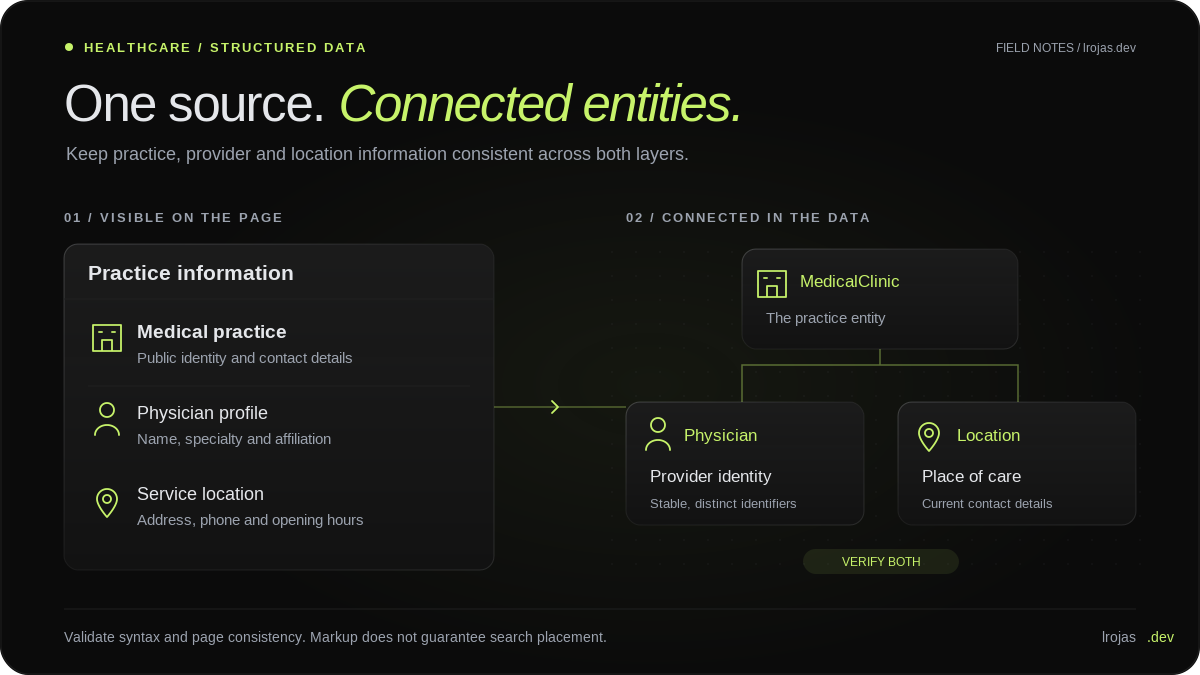
What Physician and Medical Clinic Structured Data Covers
Structured data is a machine-readable representation of information already published on a website. For a physician or medical clinic, it may include the practice name, provider names, specialties, address, telephone number, hours, coordinates, and relationships between a physician, organization, and service location. JSON-LD is commonly placed in the page source so software can interpret those entities without relying only on visual layout.
The schema type should match the entity. A practice may use MedicalBusiness or a more specific subtype such as MedicalClinic; a physician can use Physician; and a department or service location may need its own organizational or place relationship. Select a type that matches the real business and visible page content. A healthcare structured-data guide from Halcy describes MedicalBusiness, MedicalClinic, and Physician as building blocks for connecting practice, provider, and location information.
This markup describes identity and service information, not diagnosis, treatment recommendations, medication instructions, or clinical advice. A cardiology services page may identify the department, physicians, address, and appointment contact information, but should not imply a clinical conclusion about an individual visitor.
Structured data can make content easier for systems to interpret, but implementation alone does not guarantee enhanced search features, rankings, visibility, or conversions. Those outcomes also depend on content quality, technical SEO, accessibility, performance, local business information, and the accuracy of organization data.
The strongest starting point is an entity inventory: identify the organization, each physician, each service location, and the pages representing them. Markup should support that information model rather than become an isolated code exercise.
Model the Physician, Practice, and Service Location as Connected Entities
A clinic website may contain several legitimate entities that should not be collapsed into one generic business record. The parent organization may have a public name, a department may have its own specialty, and a physician may work for the organization while seeing patients at multiple locations. Each location may have separate address, telephone, hours, accessibility details, and appointment information.
Use stable, consistent naming across the site. The organization name in homepage markup should align with the header, contact page, and local profile. A physician’s name should use the same spelling and credential presentation on the provider directory, profile, appointment flow, and location pages. Addresses should use a consistent street format, city, state, and ZIP Code. Telephone numbers should identify the appropriate scheduling or location line.
Relationships matter as much as individual properties. A physician profile can identify the organization and service locations. A clinic page can identify its parent organization, while a location page can identify associated physicians or departments. Use authoritative, stable identifiers, such as an NPI where appropriate and publicly suitable. Do not invent identifiers or reuse one entity’s identifier for another.
The page architecture should reflect the entity model:
- The homepage can describe the primary organization and main location.
- A physician profile can describe one provider, credentials, specialty, affiliations, and service locations.
- A location page can describe one address, contact route, hours, services, and associated providers.
- A department or service page can describe the organization and location while linking users to responsible providers.
This prevents placing every physician, address, specialty, and service inside one difficult-to-maintain block. It also supports a clearer lead capture pipeline because the page, provider, location, and contact action correspond to one user journey.
Markup should not assert relationships that the visible page does not support. If a physician leaves a location, remove that relationship from the relevant page and update the directory. If a location has different hours from the parent practice, represent its schedule separately.
Use Authoritative Provider and Organization Data Carefully
External datasets can help check identity and affiliation details, but they do not automatically become the website’s source of truth. The American Medical Association’s Physician Professional Data describes a database covering U.S. physicians, including AMA members and nonmembers, and notes that the data supports healthcare-related initiatives. It may help with professional identity and credentialing workflows, subject to access terms and the practice’s verification process.
Federal data serves a different purpose. The Centers for Medicare & Medicaid Services Medicare Physician & Other Practitioners datasets describe services and procedures provided to Original Medicare fee-for-service Part B beneficiaries. Organized by dimensions such as National Provider Identifier, Healthcare Common Procedure Coding System code, and geography, the data can support checks involving NPI-linked records, provider identity, service context, and geographic analysis. It is not a complete directory of every current physician, commercial service, or active clinic location.
A secondary overview of the CMS Doctors and Clinicians data discusses fields such as NPI, specialties, group affiliations, hospital affiliations, and Medicare-related information. These fields can inform a review, but the website team should confirm that each record is current, applies to the organization, and accurately represents the provider’s public-facing role.
AMA and CMS data are not interchangeable. They may differ in purpose, coverage, update timing, field definitions, and eligibility. Neither replaces direct confirmation of the practice’s current name, provider roster, locations, hours, phone numbers, scheduling instructions, or patient-facing specialties.
A controlled verification process has three stages: match the provider or organization using a reliable identifier rather than name alone; compare the external record with credentialing, scheduling, location, and website sources; and publish only information approved by the practice and appropriate for the page.
Do not expose private information merely because a source contains it. Limit public markup to professional and organizational details the practice intentionally publishes. Record the source, verification date, reviewer, and affected pages to support later updates and workflow automation.
Implement, Validate, and Maintain the Markup
Implementation should begin with a page-to-entity map, not a copied template. For each target page, record the entity, visible name, canonical URL, organization relationship, location, telephone number, hours, specialties, identifiers, and content owner. Select only properties the page can support accurately. A small, coherent JSON-LD block is preferable to empty, duplicated, or speculative properties.
Place organization markup where the organization is clearly represented, usually on the homepage and relevant contact or about pages. Place physician markup on provider profiles using the visible name, credentials, specialty information, affiliations, and linked practice or location. Place location markup on pages dedicated to a specific address. If one page represents multiple entities, connect them with stable @id values rather than creating duplicate records.
Validation has two layers. Syntax validation checks whether the JSON-LD is well formed and property values use the expected structure. Content validation checks whether the markup matches the rendered page. A technically valid block can still mislead if it lists an old phone number, claims an unsupported specialty, assigns a physician to the wrong address, or copies hours from another location.
A practical review should compare:
- Organization and physician names with page headings and visible text.
- Address and telephone number with location contact details.
- Hours with the current user-facing schedule.
- Specialty and service descriptions with actual page content.
- Provider relationships with the directory and scheduling workflow.
- Identifiers and profile URLs with the approved source record.
Run validation after deployment and after changes to templates, CMS fields, provider records, or location data. A deployment check can be part of a bounded Web & Workflow Automation process: trigger review when approved data changes, compare required fields, log discrepancies, and route exceptions for human approval. Automation should not publish unverified changes merely because a source file changed.
Maintenance is a data-governance task as well as a development task. Assign owners for provider records, location details, content, and technical implementation. Review markup when physicians join, leave, change specialty, or move locations, and when the practice changes its name, opens a site, changes scheduling numbers, or reorganizes departments. Structured data remains useful only while the underlying information is accurate and visible.
A Bounded Next-Step Framework for Medical Practices
A medical practice can approach physician schema markup and medical clinic schema as a defined information-management project. The objective is not to mark up every concept, but to publish a reliable representation of the organization, providers, and locations that users can verify.
Start with an inventory. List each public-facing organization, department, physician, service location, provider profile, contact page, and service page. Identify duplicate pages, outdated profiles, mixed addresses, and provider records without an accountable owner.
Next, confirm authoritative details. For physicians, review names, credentials, specialties, affiliations, public identifiers, and current service locations. For organizations and locations, confirm the public name, address, phone number, hours, geographic details, and appointment route. Use CMS’s official provider data and appropriate professional data sources as comparison inputs, while obtaining final practice approval.
Map each page to its principal entity. Avoid publishing a provider record on a page without provider information or a location record covering several indistinguishable sites. Use stable URLs and identifiers where possible, and keep visible content aligned with structured data.
Implement the smallest useful property set first. For an organization or clinic, this may include name, URL, address, telephone number, hours, and location details. For a physician, it may include name, credentials, specialty, affiliation, identifier, and location relationship. Expand only when a property is accurate, page-supported, and maintainable.
Validate both code and content. Review syntax, required values, entity relationships, visible-page consistency, and duplicate records. Test representative templates rather than assuming one successful page proves every provider and location page is correct. Include accessibility, responsive behavior, Core Web Vitals, and page-speed checks in the broader technical SEO review; structured data should not add unnecessary scripts or interfere with page experience.
Finally, document sources and schedule accuracy reviews. A simple record can include the field, source, owner, approval date, affected URL, and next review condition. Trigger reviews when provider rosters, locations, phone numbers, hours, or scheduling systems change. Keep human approval for ambiguous changes and log errors so automation remains auditable.
This framework supports accurate machine-readable information without promising search placement, qualified leads, or conversion gains. Those results cannot be guaranteed by markup alone. The practical outcome is a clearer, more maintainable foundation for provider identity, organization data, service locations, and future technical SEO work.
Sources and references
Have a project in mind?
Tell me about your project and I'll show you how to build a fast website, improve your search visibility, or automate your workflows.
Related reading
Provider Pages vs. Specialty Pages in Medical SEO
Learn how U.S. medical websites can separate provider and specialty pages by intent, entity, and internal links to improve navigation and avoid cannibalization.
Local SEO Architecture for Specialist Medical Practices
Build a compliant local search system for specialist practices with Google Business Profile, location pages, reviews, technical SEO, and tracking.
Technical SEO for Medical Practices: Audit Checklist
Use this technical SEO audit checklist to improve your medical practice website’s visibility, performance, accessibility, and patient conversions.